
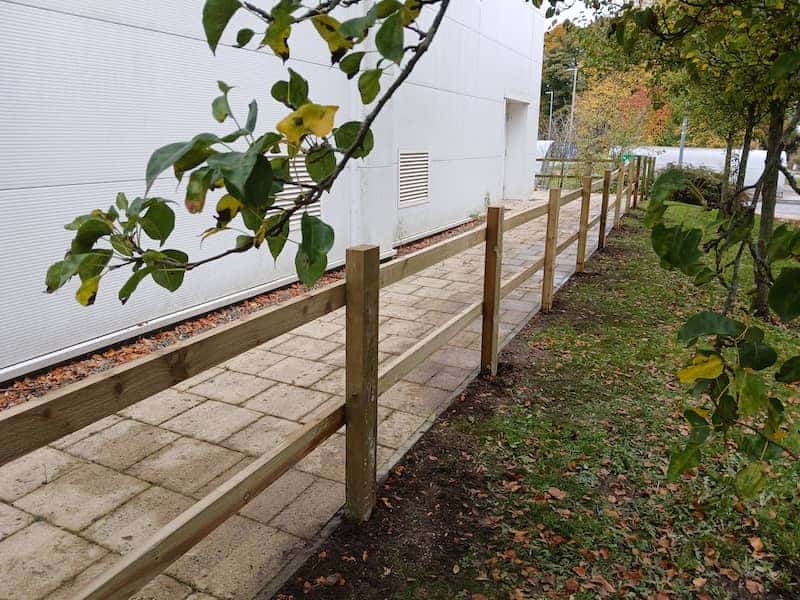
Post and rail fencing remains one of the most trusted solutions for marking boundaries and protecting land across the UK. At Ashdale Fencing, we install post and rail fencing for estates, paddocks, farms and large gardens where durability, visibility and strength truly matter.
This classic fencing system is built to define boundaries and contain livestock while preserving the natural character of the land. Unlike solid panel systems, rail fencing creates a strong barrier without blocking views. For estate and farm fencing, that balance between protection and appearance is vital.
As a company focused on long-lasting fencing needs, we design and install post and rail fencing systems that stand the test of time.
What Is Post and Rail Fencing and What Is It Used For?
Post and rail fencing is a straightforward fencing system made from vertical posts and horizontal rails. The rails slot or nail into the posts to create a structured boundary. It is widely used for estate and farm fencing, paddocks, driveways and agricultural land.
The primary purpose is to mark boundaries and create a safe barrier for livestock. It is also chosen for large gardens, hedges and rural driveways where aesthetics matter. When additional security is required, galvanised wire stock fencing or stock fencing can be fixed to the rear.
At Ashdale Fencing, we frequently enhance rail fencing with galvanised nails, galvanised wire stock fencing and intermediate posts to increase strength and longevity.

Materials Used in Post and Rail Fencing
Timber remains the most popular choice. We use high-quality timber, including incised treated wooden posts to protect against rot and moisture. Sawn Post and square post options are available, alongside round timber posts and half-round posts, depending on the design preference.
The choice of fence rail is equally important. Options include:
• Half-round rails
• D-shaped rail and unique D-shaped rail profiles
• Flat rails
• Horizontal rails with square cut straight edges
D-shaped rail designs are popular because the shape disperses pressure and improves durability. Half-round rails offer a more traditional countryside appearance.
While timber dominates estate and farm fencing, vinyl and metal systems are also available. However, timber offers a superior blend with shrubs, new shrubs and natural hedges.
Benefits of Post and Rail Fencing
Durability is a key advantage. With correctly spaced intermediate posts and Post Mix securing the base, post and rail fencing withstands harsh weather and ground movement.
Affordability is another major benefit. Compared to heavy concrete systems using Concrete Fence Posts, this fencing system remains cost-effective. Ashdale Fencing is proud to offer competitive pricing without compromising on build quality.
Aesthetic appeal also plays a role. Post and rail fencing complements Garden Furniture, Log Stores and landscaped areas. It pairs beautifully with large gardens and open countryside.
Importantly, its fence’s weight is lighter than that of many solid fencing alternatives, which can make installation more efficient while maintaining structural strength.
Different Styles of Post and Rail Fencing
There are several popular styles used in estate and farm fencing:
Split rail fencing delivers a rustic look.
Round rail systems offer smooth lines and safe edges for livestock.
Crossbuck styles create a distinctive feature for entrances.
Sawn Post and plain rail variations provide a modern, square finish.
Half-round rails are frequently selected for paddocks. Flat rails with straight edges offer a contemporary aesthetic.
Decking Boards and Gravel Boards can also be incorporated at ground level for additional support and durability.
Choosing the Right System for Your Land
Selecting the right post and rail fencing depends on terrain, livestock type and overall use. On uneven ground, round timber posts can adapt better to movement. Where heavier animals are present, additional horizontal rails and galvanised wire stock fencing may be required.
Replacing an existing fence? We assess spacing, soil condition and whether Concrete Fence Posts were previously used. The fence’s weight and timber dimensions will influence installation depth.
We also discuss your wish list in detail. Some customers want decorative square cut finishes. Others prioritise durability above all else.
Installation Process
Installation begins with setting out the line and marking spacing for intermediate posts. Holes are dug and Sawn Post or Half Round Posts are secured using Post Mix for stability.
Rails are then fixed using galvanised nails or nails suited to external timber. The fencing system is aligned carefully to ensure straight edges and consistency across the boundary.
Our experienced team at Ashdale Fencing understands how critical secure installation is for estate and farm fencing.
Maintenance Advice
Post and rail fencing is relatively low maintenance. We advise regular checks for loose rails, damaged posts or shifting ground. Any broken rails should be replaced promptly.
Treated timber reduces rot risk, yet inspections remain important, especially where livestock lean or rub against rails. Shrubs and new shrubs should be trimmed to avoid moisture retention around posts.
Frequently Asked Questions
What are the main differences between rail fencing and stock fencing?
Rail fencing uses visible timber rails for structure and appearance. Stock fencing typically refers to galvanised wire stock fencing designed purely to contain livestock. Many estate and farm fencing systems combine both for strength and safety.
How does a D-shaped rail affect durability?
A D-shaped rail distributes pressure more evenly. The curved front sheds water effectively, reducing moisture retention and improving long-term durability.
What timber types are commonly used?
Softwood timber, pressure-treated and incised-treated wooden posts are most common. Square posts, round timber posts and half-round posts are used depending on design and performance needs.
Does the fence’s weight impact installation?
Yes. Heavier rails require deeper post settings and stronger Post Mix foundations. Lighter systems are faster to install but must still meet livestock containment standards.
Can decking boards be incorporated?
Decking Boards can be added to create a more enclosed appearance, particularly in large gardens or where gravel boards are required at ground level.
Why Ashdale Fencing for Post and Rail Fencing?
We specialise in estate and farm fencing across the region. Our team handles trade enquiries, site visits and phone calls professionally, ensuring every fencing need is understood.
We combine competitive pricing with technical experience, delivering strong, attractive rail fencing that performs year after year. Whether you are protecting livestock, defining hedges or upgrading an existing fence, Ashdale Fencing provides a reliable solution tailored to your land.
Ready to Upgrade Your Estate or Farm Fencing?
Contact Ashdale Fencing today to discuss your post and rail fencing project and request a no-obligation quote.
You may also like:


